Santiago, Chile

Santiago, Chile

Wednesday, August 25, 2010

2010: Something to celebrate

When I came to Chile three years ago I had the distinct impression that Chileans were not like their proud neighbors to the east, Argentina and Brazil. With no World Cup trophies, no post-card quality women or beaches, and no traditions of tango, Chileans seemed to view themselves as the nerdy cousins of these South American giants. Admittedly, I had to agree. If you look at a map of South America, Chile is like the crust on the bread that is the rest of the continent. It clings on to a rocky shore, a narrow strip about to crumble into the ocean. The most common question I was asked wasn't the usual "Do you have a boyfriend?" that I heard in other parts of Latin America, but rather "Why did you come to Chile?". I was never able to formulate an adequate response.

After doing some research I learned that it wasn't just coincidence that everyone I met wondered why foreigners came to Chile. I read about the country's national identity crisis; possibly due to its history of violent conquest and dictatorship, its geographic isolation, or its cultural austerity, Chileans have gained a reputation (which they seem to have internalized whether it's true or not) of being small, quiet, hard-working, and very humble.

On my second journey here, I feel I have discovered an answer to the question that seemed to plague so many Chileans. This country is magnificent- blessed with mountains, beaches, glaciers, deserts, salt flats, rivers, volcanoes, and lakes. It's safe, modern, and easy to live in. The economy is good, which is really the main reason why I came. And although it isn't exactly Sweden, its social programs put it ahead of the US in caring for its citizens. And now I can add to the list the amazing people I have met here.

The best thing of all, though, is that it seems like Chileans themselves are starting to realize how great their country is. After a natural disaster, the culture of a country can change dramatically, people get swept up in a wave of patriotism (think post 9/11). After the earthquake in February that killed over 500 people and displaced millions, Chileans worked together to rebuild destroyed homes and feed their compatriots. Although I wasn't in the country to witness this, I have been here to witness its aftermath.

Since the nationalistic cultural shift, several other events have given Chileans the opportunity to wave their flag with pride: the historic World Cup victory over Honduras and the national team's advancement to the second round, the tragedy (and the glory) of the accident that trapped 33 miners in Copiapo, and soon dieciocho (September 18), the day Chile will celebrate its bicentennial.

In the three years since I'd been away, Chile changed a lot. Although I still get asked why I came here, the question no longer implies that Chile isn't worth visiting. Chileans are more open to me, and I am more open to them (after all, 3 years have changed me, too). This year seems to be a turning point for Chile; a new president, a natural disaster, a record-breaking sports victory, a national drama, and a 200th birthday. Like the world-class wine its sun-soaked valleys produce, Chile just gets better with age. Feliz cumpleaƱos!

Wednesday, August 18, 2010

Transantiago vignette

When I first arrived in Chile in 2007, they had just initiated a new transit system in Santiago, the Transantiago bus/metro system. To me, it was efficient and logical, but to the Santiaguinos who were used to frequent, empty, cheap buses (which contributed to the terrible smog) it was an infuriating change. My first trip to Chile was marked by regular protests and strikes of the bus system. Things have calmed down in the past three years, however, and now most people, though still dissatisfied with Transantiago, have come to accept it as part of life in the city.

I am a privileged gringa because I get to spend an average of three hours a day on the metros and micros of Transantiago. Although I teach English for a living, I consider myself more of an anthropologist by vocation, and I can assure you there are few situations better suited for anthropological study than public transportation. I can classify almost any Santiaguino into one of two categories: metro riders and micro riders. Metro riders value efficiency and speed and they prefer not to talk to strangers. When you ride the metro, no one looks at each other, everyone stares at the ground in front of them in silence. You can be packed in at rush hour, your body pressed up against five other people, and yet you still have to find a way not to make eye contact with anyone. Metro riders wear black.

Micro riders, on the other hand, would rather have a nice view and save a few cents than get to their destination quickly; they are generally friendlier and will always give up their seats for an old lady or pregnant woman. Someone is always striking up a conversation with me, teenage boys sit in the back of the bus and play reggaeton on their cell phones, and the drivers usually say hello to the passengers as they board. There's always a vendor or musician who hops on board to peddle chocolate, flashlights, pens, books, or play some Chilean folk music. Certainly it's more fascinating than the metro.

Generally speaking, I consider myself a micro person because I save money on the transfer, I enjoy the view, and I like the entertainment. But yesterday I had the worst public transportation experience of my life, and it made me realize why so many people are still so bitter about Transantiago.

I was leaving work in the south of the city and the bus was running 15 minutes late. There was a line of people at the stop waiting with me, and when the bus finally came it was already packed, forcing us to cram in as close as possible. When I made it past the turnstile I noticed a rank smell and realized someone had vomited on the floor. There was a big spot covered in ripped up newspaper that had already been trodden on, over which no one wanted to stand (naturally), so the already crowded bus had even less room. So we're standing here, running late, packed in, trying not to step in vomit but not being able to avoid the smell, which just makes you want to throw up yourself.

Bad enough, no? Well I finally found a spot where I could hold on to a pole and not have to step in the mess on my way out the door, when this homeless man boards the bus from the back without paying. The guy looks like he was just discharged from the hospital; his arm is in a cast, his face is bruised and bleeding, he's got blood on his shirt and hands, and he smells like he hasn't showered since the era of Pinochet. He's about two feet taller than me, and he's got his natty hair wrapped up in one of those Palestinian bandanas, and he's wearing combat boots. He was a pretty intimidating figure, and naturally, he comes to stand right next to me. The old lady standing nearby holds her nose and scoots to a different corner of the bus to avoid smelling him. So there I am, trapped between the homeless man who looks like he just got into a brawl and the puddle of vomit covered in shoddy newspaper, running late for my next class all because the micro ride was free. I think after all, I might become a metro person.

Sunday, August 1, 2010

Who needs measuring spoons?

Somehow, before today I had not managed to solidify my reputation as a great chef. The most labor-intensive foods my roommates witnessed me making were tuna sandwiches and scrambled eggs. But today was cold and rainy, and I had no plans, so I decided to go on another culinary adventure. I'd been craving hummus, and the day called for squash soup, so I decided to try to make both.

Cooking in a foreign country is complicated. The metric system messes up all your measurements; the ingredients are hard to find (if you can figure out how to say them in the local language) and expensive; and in my case, the gas oven has no temperature setting, so you have to eyeball the size of the flame ("yea, that looks about 450 degrees"). Thanks to Jumbo (Chilean Wal-Mart), I found tahini, garbanzos, nutmeg, ginger, and squash and was able to make some tasty hummus and a big pot of soup. The squash was super hard to cut, and that process alone took about an hour. But once I had it boiling with carrot, onion, apple, garlic, and spices, it was snap to blend it up and enjoy.

I was so inspired by the success of my soup that I decided to try roasting the seeds, and since I had a ton of leftover squash I made pumpkin bread. I added Old Bay to the seeds since everyone has loved it (we add to potato chips religiously). I think I should start an Old Bay importing business to cater to the heavy demand I am creating down here.

Today I spent four and a half hours in the kitchen cooking and cleaning, but it was worth every minute to eat some delicious food and share a piece of culture with my roommates. After hours of cooking, the kitchen was the only warm place in the apartment, so my roommates and I huddled together sampling all the delicious food I'd made. It was an important bonding moment for me. Although they've lived with gringas for years, they had never eaten anything I made today. I don't even mind that I bought all the ingredients and spent my whole day working, because to me that's the best part of being in another country: when you share a part of your culture with someone, and they dig it.

Pumpkin seeds and soup


Hummus


Pumpkin bread from scratch


Bonding with a roommate, Rodrigo ("abuelo")

Friday, July 16, 2010

A la Anthony Bourdain

It's early Friday afternoon and my roommates are still sleeping after a night of pisco and local wine, so I've decided to go on a mission to the Mercado de Providencia to buy some fish to grill on this lovely national holiday. Thanks to some saint, it's a perfect day to venture downtown; the streets are clear of the usual business crowds and the annoyingly slow Chilean pedestrians who meander left and right, stopping to window shop or buy a chocolate bar from the newsstand. Today the streets are empty except for a few Chilean families riding bikes or sipping coffee at a sidewalk cafe. And despite being mid-winter, the sun blazes down so warm that I would be more comfortable in a tee-shirt and sneakers than the wool sweater and boots I put on this morning.


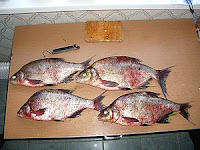
Reineta


When I get to the market the vendors are still setting up. I successfully negotiate the purchase of a whole reineta ("Southern Rays Bream" according to the internet), skinned and de-boned, for about five dollars. A couple of big, juicy lemons cost me 30 cents, and then I head to the
empanada stand where you can get the best turnovers in Santiago filled with cheese, ham, mushroom, seasoned beef, or seafood. On a more frivolous day I would opt for the unexpectedly delicious shrimp and cheese combo, but today I stick with the basic cheese. The soft, buttery crust is filled with the warm, gooey cheese that doesn't seem to have any particular name but it's soooooo good.

As you can see, food occupies a lot of my thoughts and activities in Chile. There are so many local specialties and I feel obligated to try them all while I am here. To begin with, Providencia (my neighborhood) has bakeries on every corner like you have Starbucks at home. I pass probably 10 CastaƱos on my way to work in the morning, and who could resist stopping in for a muffin, medialuna, empanada, or some delicious pastry filled with manjar (a rich, milky caramel)?
Then there are the famous sopaipillas, little flat discs of fried squash dough that you can top with mustard, ketchup, or aji (spicy pepper sauce), for just 20 cents apiece.


A pastry filled with manjar


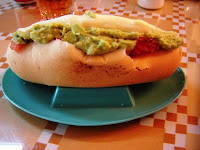
Chileans themselves prefer completos, giant hot dogs "Italian style"- topped with tomato, mayo, and smashed avocado (the name comes from the red, white, and green colors). Of course, you can get anything "italiano", hamburgers, sausage, or my favorite, lomito- shaved pork loin served on a toasted buttery roll.


A completo italiano


Another favorite among Chileans is ice cream. A friend told me that Chileans eat more ice cream than anyone else in the world, and though I find that statistic hard to prove, the evidence makes it hard to disbelieve. Every day I see Chileans bundled up in coats, gloves, hats, and scarves licking on ice cream cones as they walk down the street. McDonald's has adapted to the market by opening express windows on the street that sell only soft serve cones, sundaes, and McFlurry's.

Although I don't dine out often, there are also some great fine dining spots in this town. My roommate's friend is visiting from the US right now, so we all went out to a traditional Chilean restaurant known for its grilled meat. You can get a steak three inches thick grilled to perfection- not bloody on the inside or burnt on the outside. And of course, each meal comes with fries and bread to soak up the juices.

All I can say is it's a good thing I am doing 6 hours of capoeira a week or else all this gormandizing might be the death of me...

Sunday, June 27, 2010

A Day in the Life

It's been a bit since I've written because I feel like I should have something interesting to write about rather than mulling over the day-to-day routine. But after some reflection I realize that perhaps that daily grind in Santiago might be of interest to the folks at home who are blasting the air conditioning and dreaming of snow-capped mountains. So, I apologize if this blog is a bit dull, but let me attempt to give you a little taste of my life.

Mondays through Fridays I teach classes during the day. Right now I only have three classes: a private lesson with a 35 year-old marketing manager who works for Bell Microproducts, a group class with 6 students from Movistar, and another private lesson with a finance manager at Cardif insurance. The first two are level one, so beginner/intermediate. We do a lot of grammar and basic conversation practice. The finance manager is level 4, so he is pretty advanced. I try to find authentic texts (podcasts, articles, or other things that are made for real people rather than the classroom) on subjects that will interest him to make the hour and a half class go by quickly. When I'm not teaching I have to check in at the Comunicorp office every day. I use the time there to plan my lessons and familiarize myself with their resources.

My boss is a nice woman, but she can be pretty intense. She is always willing to help me out, and she seems to have a great mind for business. Everything she does is to improve the Comunicorp image and sell more classes, so it's important for her to make sure that we know what we're doing and get all the help we need. Recently there has been a lot of turnover in the teaching staff, so my roommate and her veteran friends and just getting to know me and the other knew recruits. Maybe it's just me, but there seems to be a little tension in the air. I hope that after the next staff meeting we will get a chance to know each other better and hopefully make friends.

Outside work, I go to yoga Mondays and Wednesdays with my roommate and a couple other teachers, and I go to capoeira Tuesdays, Thursdays, and Saturdays. I used to practice capoeira in the US with a Chilean teacher, and he recommended this school to me. I was a little nervous about showing up by myself, hoping I would be able to understand all the instructions and that the other students wouldn't look at me like a crazy gringa (always a risk...), but when I showed up I was greeted with hugs and kisses, and the group was really happy to have one of Bucho's students join them all the way from America. I confess to enjoying not just a little the room full of young Chilean men in perfect physical form, many of whom seem to find my blue eyes and light hair exotic. I don't necessarily mind the attention. Although there aren't many other girls in the class, they are also really nice and welcoming, which I haven't experienced very often among Chilean girls. There is definitely a sense of community there, and I am glad I found the group so quickly.

Unfortunately, my social life so far has been a bit lacking. I have my roommates, and a few random contacts to hang out with, but somehow on weekends I spend a lot of time waiting to go out and do something, often to be let down at the end when the rest of the crew decides they don't feel like doing anything. I enjoy hanging out around the house with them, but either I need to bring the party and animate them to go out more, or I need to find a group of friends who is always up for an adventure. I am thrilled to be in Chile, but these are the moments when I miss the awesome group of friends I had in Baltimore, where there was never a boring weekend!

Until I find a crew like that down here, I am trying to make the best of time spent relaxing at home, which I never did enough of in Baltimore. I've only been here for three weeks and I'm sure that in time as I get to know my fellow capoeiristas better and make more contacts, I will probably be just as busy as I was back home.

What else can I tell you about daily life? Feel free to send me some questions and give me an inspiration of what else to write about...

Wednesday, June 16, 2010

The Chaos

South Americans have a knack for chaos, regardless of whether they are expressing triumph or dissent. In 2007 when I was in Chile, the universities were closed regularly for strikes, and the newspapers featured pictures of encapuchados, kids with those famous Palestinian bandannas over their faces throwing molotov cocktails at the attacking guanacos, police tanks that sprayed tear gas. At the time, I witnessed the riots from the safety of my apartment in an upper middle-class neighborhood.

Little did I suspect that, much like my beloved Terps, Chileans riot out of celebration, too. Today Chile won their first World Cup game since the 1962 match against Yugoslavia in Chile. Today's win was their first ever World Cup victory abroad.

Although most male-dominated offices in machista Chile were closed for the morning due to the post-game celebration, I had one female student to teach across town who didn't feel the need to cancel our lesson due to soccer. On my way home most buses, already loaded down with flag-waving fans, passed me by. When I finally caught one it was filled with teenagers dressed in Chilean flags, singing and chanting endlessly and jumping so hard the bus literally bounced down the street.

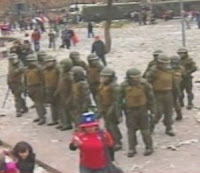
A few blocks south of the stop where I was to get off the bus made an impromptu turn because police had blocked the road. I got off there and headed towards my next bus stop, veering around the cheering, drunken, brawling masses until my eyes and nose started to sting a little. As I walked, the street got emptier, and my face started stinging more and more. A few remanining encapuchados were throwing rocks and vodka bottles at the police tanks, and I saw a white cloud burst out of the guanaco half a block away from me.


Plaza Italia, scene of the party and rioting


Police breaking up the crowds


I tried to avoid the chaos by taking the metro, but they had it barricaded shut. The intersection where I was headed was blocked off too, so it would be impossible to catch a bus. Covering my nose and mouth with the corner of my coat to avoid inhaling the tear gas, I jogged to the nearest avenue to catch any bus headed away from the scene. None were stopping. Finally I was able to flag down a cab, but once I was inside my eyes started watering, and the more I cried the more it burned. Three blocks down I was sobbing into my coat, sputtering in the only Spanish I could remember asking the cab driver how to make it stop. He wasn't able to offer me any useful advice.

After I got home I took a shower and rinsed my eyes for a few minutes, and the burning sensation started to lessen. Unfortunately, so did my excitement at being in Chile for such an important victory. I have had great experiences watching games abroad in Mexico, Chile, and Spain. I have hugged strangers after a game-winning goal and relished stories about soccer's ability to stop wars and bring together different cultures and ethnicities. Although I had heard horror stories about riots and hooligans, I never experienced first-hand the violent side of "the most beautiful game". My attitude changed from cheering the Chileans this morning to cursing them this afternoon. I think for the next match, I won't be leaving my house.

Spanish speakers, read the El Mercurio article